
 Reviewed by
Michaël Maarek
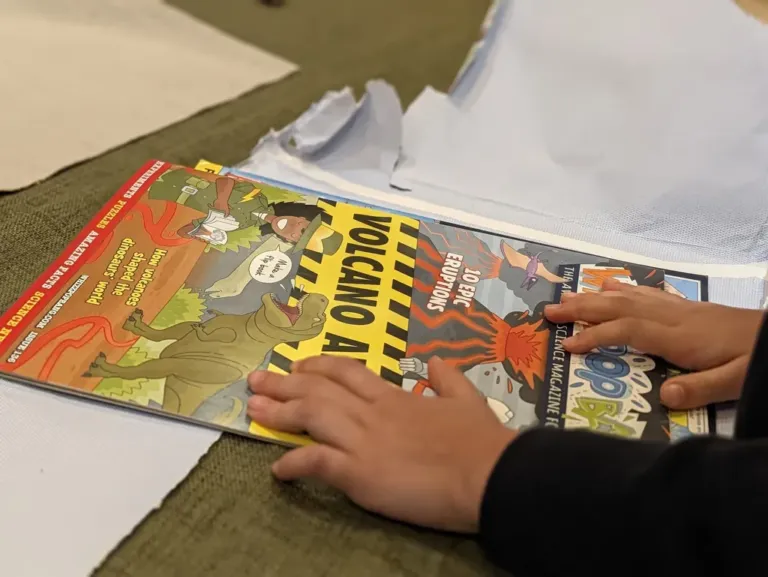
My Whizz Pop Bang review in one line: it is a science magazine that genuinely holds children’s attention, and one issue goes a long way when several kids share it. Whizz Pop Bang is a monthly British science magazine for 6 to 12 year olds, from £6.50 a month or about £5 an issue on the annual plan, UK postage included. We had two issues to try, Flying High on the science of flight and Volcano Alert, and it was the volcanoes that grabbed my daughter. The facts were good, the activities were fun, and the little volcano flip book we made together was the highlight. Here is what is inside, what we actually did with it and whether it is worth the money.
Whizz Pop Bang at a glance
| What to check | Our experience |
|---|---|
| Issues we tried | Issue 135, Flying High, and issue 136, Volcano Alert |
| Format | 36 pages, one theme per issue, no plastic cover gift |
| Price | £6.50 a month, or £59.99 a year (about £5 an issue), UK postage included |
| Our favourite activity | The volcano flip book: cut out, stack, flick, eruption |
| What you need | Scissors and a pencil for most pages; kitchen cupboard items for the experiments |
| Best for | Curious children who like to make things, and families who will sit down with them |
For plans, gift subscriptions, delivery dates and cancelling, see our Whizz Pop Bang prices and plans page.
Two issues, two themes, one clear winner
The two magazines could hardly be more different. Flying High covers how aeroplanes stay up, drones, a cut-out stunt plane and flying pterosaurs. Volcano Alert goes underground: magma, plate tectonics, the rock cycle and how volcanoes shaped the dinosaurs’ world. I let my daughter choose, and she went straight for the volcano. That is the first thing I liked about the format: with a different topic every month, there is a good chance one issue hits exactly what your child is into at that moment, and that is when a magazine really gets read.
Inside the Volcano Alert issue
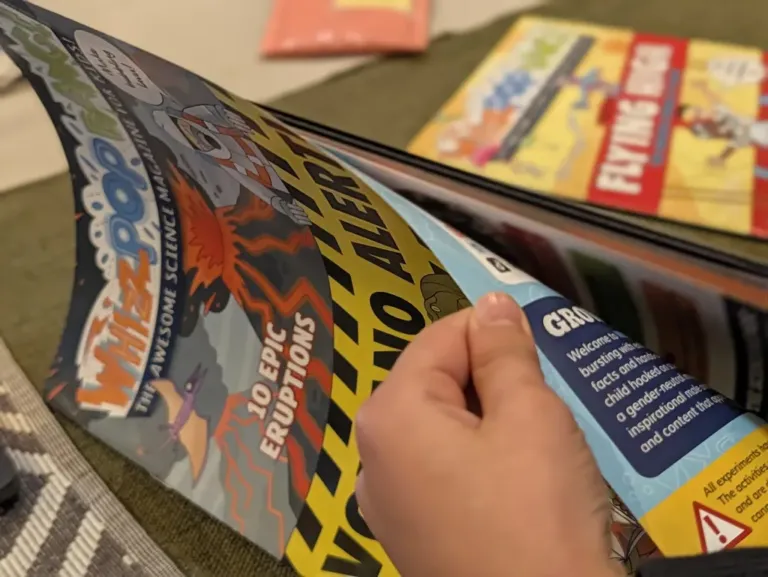
The issue builds the same idea up from several angles, which is clever. A comic follows Y, the magazine’s robot, down through the Earth’s crust and out of an erupting volcano. Two pages later, a big cutaway drawing labels the magma chamber, the main vent, the crater and the ash cloud. Then the rock cycle gets the same treatment, followed by a portrait of James Hutton, the Edinburgh geologist who worked out how old the Earth really is. By the end-of-issue quiz, words like magma and tectonic plates have come up so often that the answers come easily, which is exactly the point.
There are proper “did you know?” facts all the way through, the kind children love repeating at dinner. A few from this issue:
- Scientists have found traces of an ancient supervolcano under Norfolk and Lincolnshire that last erupted about 454 million years ago.
- Snowdon, in Wales, is an extinct volcano, and Edinburgh Castle sits on the remains of another.
- Marine iguanas in the Galápagos sneeze out salt, which leaves white crusts on their heads.
- The 1883 Krakatoa eruption was heard more than 4,800 km away.
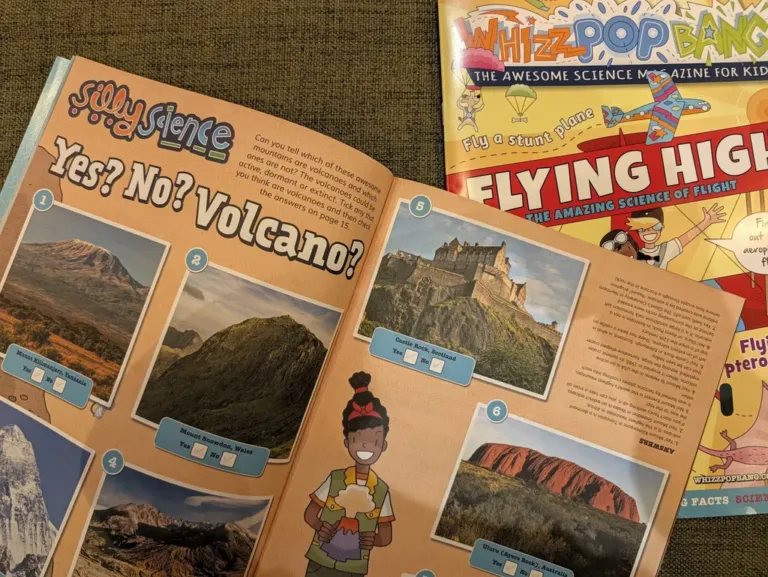
The Yes? No? Volcano? pages were a good example of the tone. Seven photos of famous peaks, from Kilimanjaro to Uluru, and you tick whether each one is a volcano. The answers are printed upside down on the opposite page, so nobody has to go hunting for them.
The best bit: making the volcano flip book
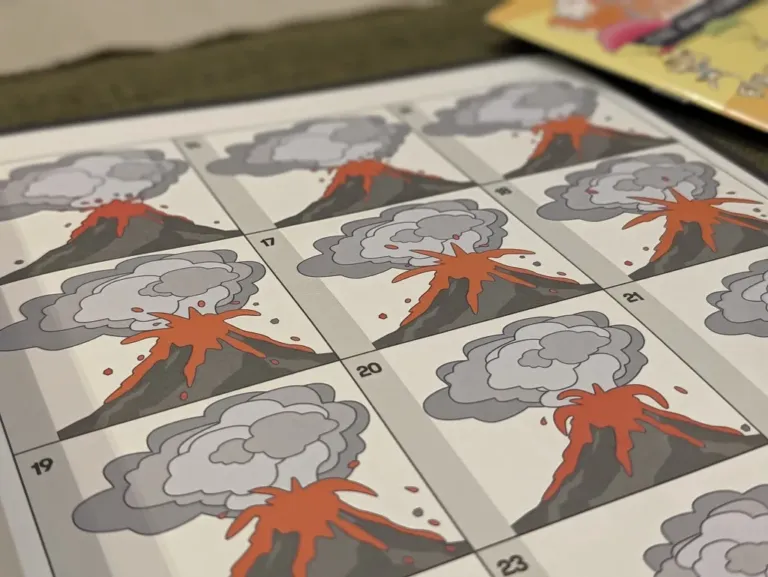
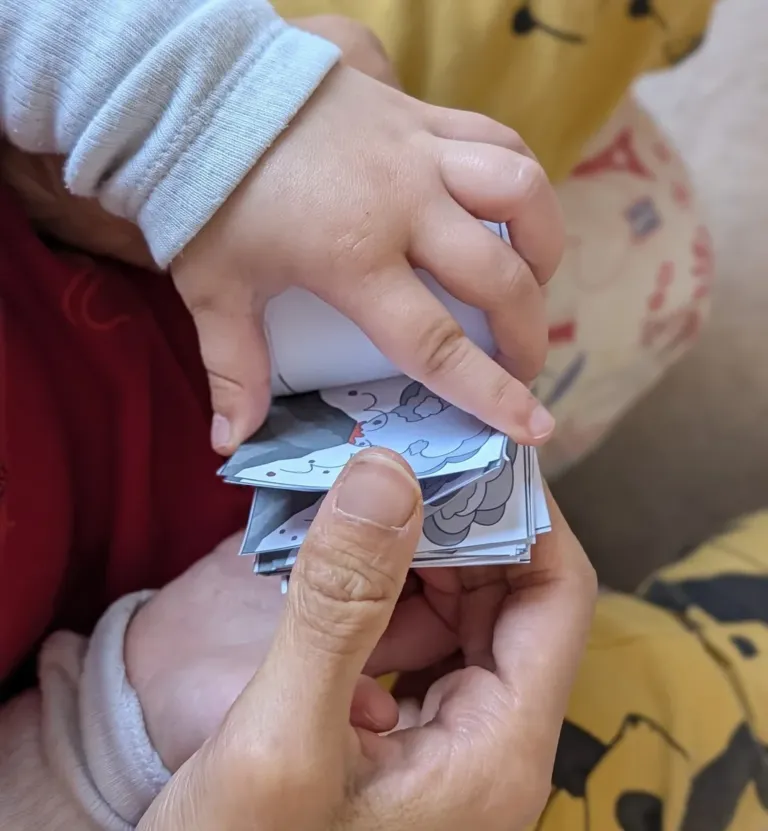
The activity we enjoyed most was the mini flip book in the centre pages. Each frame shows the same volcano a moment later in its eruption, with a number in the corner. You cut the frames out, stack them in order, hold the stack tight at one end and flick through with your thumb. The lava bursts out of the crater and the ash cloud grows as the pages go by.
It was a really lovely thing to do with my daughter. The cutting is the part where a grown-up helps, and the numbers make the stacking a small game in itself. Then comes the moment you flick it for the first time and the volcano actually erupts in your hands. It needs no special kit and no reading at all, and it turned the science of the comic into something she could hold.
The other activities in the issue
The flip book is only one of the hands-on ideas. Here is what the rest of Volcano Alert asks for, so you can see how much of it you can start straight away.
| Activity | What you need | Grown-up needed? |
|---|---|---|
| Volcano flip book | Scissors | Help with cutting for younger children |
| Make an erupting volcano (foam from a bottle) | Bottle, yeast, hydrogen peroxide, washing-up liquid, goggles and gloves | Yes, to handle the peroxide |
| Bubble Trouble (why thick magma explodes) | Two glasses, straws, water and syrup or honey | Not flagged |
| Make edible rocks | Milk and white chocolate, foil, cupcake cases, a bowl of hot water | Yes |
| Fiery jam jar lantern | Empty jar, paper scraps, tissue paper, PVA glue, hole punch, tea light | Yes, if you use a real candle |
| Electric volcano (static) | A balloon and some hair | No |
| Maze, anagrams, word search, quiz | A pencil | No |
Most of it really is kitchen cupboard stuff, and subscribers get an email listing the month’s kit before the magazine lands. Hydrogen peroxide is the one item most homes will not have, so check that list if you want to do the big foam eruption on day one.
Something for every child in the house
What surprised me most is how well one copy is shared. The children were genuinely interested, each in a different part. The more visual pages, like the photo quiz, the lava maze and the hunt for a tiny piece of science equipment hidden on every double page, need little or no reading. The anagrams, the jokes and the eight-question quiz suit confident readers. And because no issue is about one single thing, there is usually a page for the dinosaur fan, one for the child who wants to make something and one for the one who just wants weird facts.
It also does not feel like homework. The text comes in short boxes, there are comics and puns everywhere, and the cast of characters (Y the robot, Emmi, Riley, Gakk the alien and Atom the dog) keeps it friendly. Fair warning for parents: the puns are relentless.
The Flying High issue
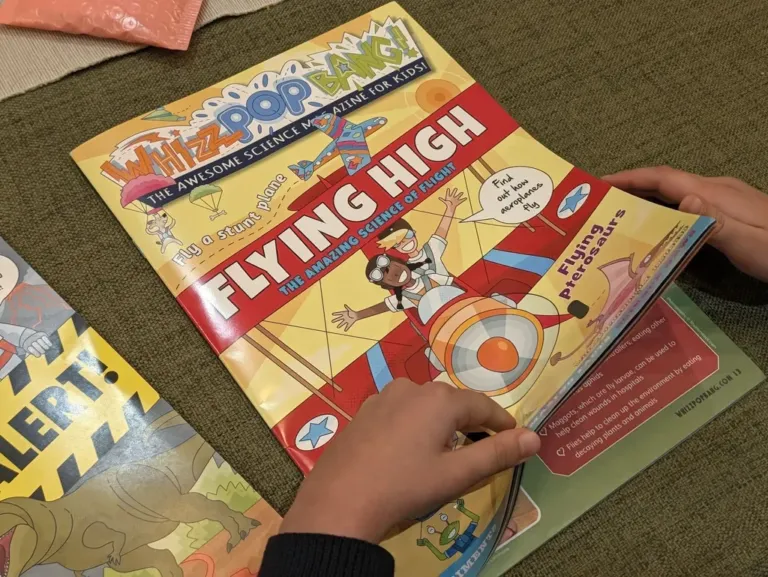
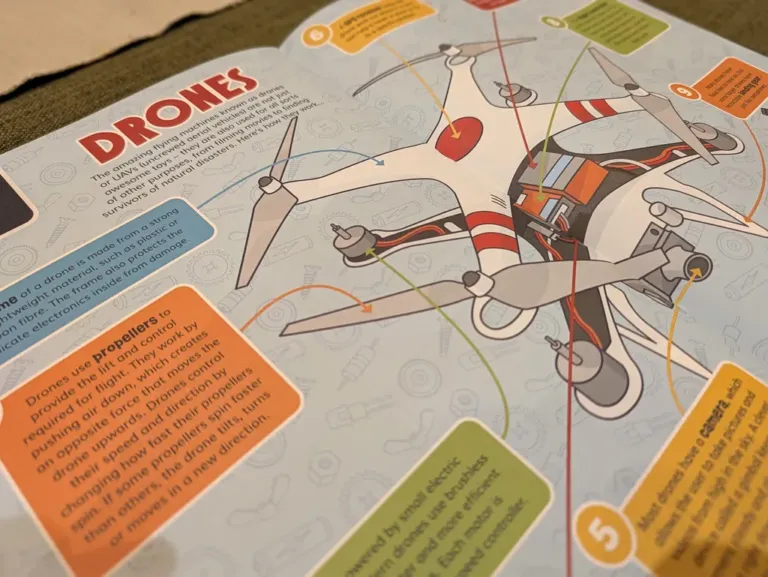
We have mostly dipped into Flying High so far, but it follows the same recipe. There is a cut-out stunt plane to make, a page of riddles, a big How Stuff Works cutaway of a drone and a section on flying pterosaurs. If your child is more of a builder than a geologist, this is the issue I would hand them first.
What could be better
- It is a magazine, not a kit. Nothing comes in the envelope except the pages. The experiments only happen if an adult gathers the bits and finds the time. If you want everything in the box, a science kit subscription suits you better.
- Some activities need supervision. The foam volcano uses hydrogen peroxide, the chocolate rocks need hot water and the lantern can take a real candle. The magazine flags these clearly, but they are not things a child can do alone.
- The wordplay assumes a fluent reader. Anagrams and puns are where younger children will need someone reading with them.
- The back page sells. There is no paid advertising, but the back cover of our volcano issue promotes Whizz Pop Bang’s own Christmas books and kits.
Is Whizz Pop Bang worth it?
Yes, if someone in your house will sit down with it. On the annual plan, an issue works out at about £5, and £6.50 on the monthly plan, with postage included. A single back issue costs £6.99 in the Whizz Pop Bang shop, so subscribing is the cheaper way to get it every month. For that you get a dozen activities, a stack of facts and puzzles, and enough variety that two or three children can each find their own corner of it. For comparison, Launchpad’s own Letterbox Lab science kits start at £14.99 a box.
The value depends less on the price than on use. Read once and recycled, it is a nice magazine. Used the way we used the volcano issue, picking the activities that match what your child loves, it gives you real moments together, and that is where it is very good value.
Our verdict
Whizz Pop Bang is one of the easiest kids’ subscriptions to recommend. It interests children without dumbing anything down, the theme changes every month so there is always a way in, and one copy happily goes round several children. Making the volcano flip book together is exactly what a children’s magazine should give you. It is best for curious 6 to 10 year olds and parents or grandparents who like doing things with them. It is less suited to families looking for a box of components, or to a child who will be left to read it entirely alone.
Frequently asked questions
Whizz Pop Bang review: your questions answered
Is Whizz Pop Bang worth it?
For curious children, yes. At about £5 an issue on the annual plan, you get a full themed magazine with experiments, crafts, puzzles and facts. It is best value when an adult helps with a few of the activities, like the volcano flip book we made from issue 136.
Can siblings share one Whizz Pop Bang subscription?
Yes, and it works well. Our children were interested in different topics, and each issue mixes picture-led pages and mazes, puzzles and jokes for confident readers, and experiments everyone can join.
Is Whizz Pop Bang good for children under six?
Partly. The comics, photos, mazes and cut-out activities like the flip book work with a grown-up alongside. The reading-heavy puzzles and puns are aimed at the 6 to 12 range, so younger children will need someone to read with them.
Do you have to do the experiments?
No. There is plenty to read, spot and solve with just a pencil. But the experiments and makes are where Whizz Pop Bang shines, and most use household items listed in an email before each issue.
How do you make the Whizz Pop Bang volcano flip book?
Cut out the numbered frames from the centre pages of the Volcano Alert issue, stack them in number order, hold the stack firmly at one edge and flick the pages with your thumb. The volcano erupts as the frames go by. Younger children will need help with the cutting.
What is in the Whizz Pop Bang Volcano Alert issue?
Issue 136 covers plate tectonics, a cutaway of a volcano, the rock cycle, marine iguanas, ten famous eruptions, volcanoes in the age of the dinosaurs and geologist James Hutton. Activities include a foam eruption, edible chocolate rocks, a jam jar lantern, the flip book and a lava maze.
Can you buy the volcano issue on its own?
Yes. Issue 136 is sold as a back issue in the Whizz Pop Bang shop for £6.99, which is a good way to try the magazine before subscribing.
Does Whizz Pop Bang feel like schoolwork?
Not in our experience. It links to the primary curriculum, but the short text boxes, comics, jokes and hands-on activities make it feel like a fun magazine rather than homework.


Questions & reviews
Have a question about this box?
Share a question, opinion or experience. Our team reads every message and will reply.