
 By
Michaël Maarek
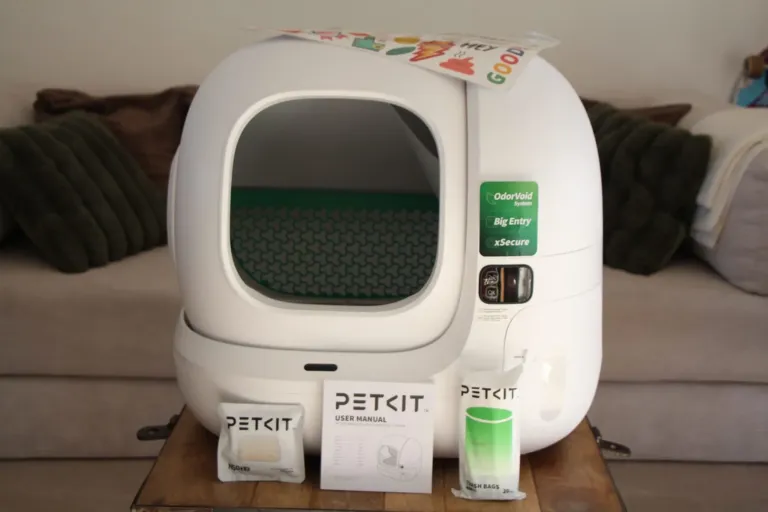
A self-cleaning litter box promises the end of daily scooping and of that smell you notice the moment you open the front door. The differences that matter are elsewhere: whether your cat will actually use it, how well it really controls odours, how much room it takes, what you will spend on bags and refills, and whether you want a camera watching the litter tray. We lived with a Petkit Purobot Max 3 and a rather shy cat for several weeks, and compared it with 11 other self-cleaning litter boxes sold in the UK, from a £49.49 manual rolling tray to the £999.99 Petkit Purobot Ultra.
The short answer: for a home where smells are the problem, the Petkit Purobot Max 3 is the one we would buy: it left no bad smell in the kitchen where it sits. For the best-known name and a very open globe, the Litter-Robot 4. For big cats, the Litter-Robot 5. If you want a camera to keep an eye on your cat’s health, the Petlibro Luma. For cats that refuse a hood, an open-top model: the Neakasa M1 Plus, or the cheaper CATLINK Open-X.
Our picks
- Best overall for odour control: Petkit Purobot Max 3 (£599.99). Closed drum, sealed 7-litre bin, deodoriser and a complete app, with no camera. Tested by our reviewer with her cat: 8/10.
- Best known and best for multi-cat homes: Litter-Robot 4 (from £699). The globe that made the category famous, for cats from 1.36 to 11.33 kg, with a 2-year warranty and a 90-day trial.
- Best for big cats: Litter-Robot 5 (from £899). The widest weight range we found, from 1.4 to 13.6 kg.
- Best with a camera: Petlibro Luma (£699.99). AI video of each visit, an 11-litre bin, a 24-month warranty and a 90-day in-home trial.
- Best Petkit with a camera: Petkit PurobotMax Pro 2 (£699.99). The Max 3 formula plus an AI camera, cat face recognition and an 8-litre bin.
- Best open-top: Neakasa M1 Plus (£549.99). No hood for cats that hate enclosed trays, and roomy enough for large breeds.
- Best budget automatic: CATLINK Open-X (£229.99). An open-top automatic box with a 12-litre bin for under a third of the price of the premium models.
- Best for any litter: PetSafe ScoopFree SmartSpin (£399.99). PetSafe says it works with any litter, for cats up to 11 kg.
How we chose: 12 models analysed, 1 tested hands-on
We compared 12 self-cleaning litter boxes that UK cat owners are most likely to consider: from Petkit, the Purobot Max 3, PurobotMax Pro 2 and Purobot Ultra; from Whisker, the Litter-Robot 4 and Litter-Robot 5; the Petlibro Luma; the Neakasa M1 Plus; the CATLINK Open-X; from PetSafe, the ScoopFree SmartSpin and ScoopFree Crystal Pro; the PetSnowy SNOW+; and the Omega Paw Roll’n’Clean.
- Petkit Purobot Max 3, tested at home for several weeks by Alexandra Miglis with Tétine, her shy cat. The litter box sits in her kitchen. Read the full Petkit Purobot Max 3 review.
For the other models we read the brands’ UK product pages and specifications (cat weight range, bin size, compatible litter, camera, warranty), compared usual UK prices on the official UK stores, and on Amazon.co.uk and Zooplus for the two models without one. Our own test gave us the grid we used to judge them.
What our testing taught us
Alexandra mainly hoped to be done with daily scooping. What won her over most was the smell, or rather its absence:
The big argument that makes the difference is, without hesitation, the total absence of bad smells.
Living with the Purobot Max 3 showed what really separates self-cleaning litter boxes:
- Your cat decides, not the spec sheet. “The first night, she refused to go near the new litter box.” Tétine had a few accidents next to it before she adopted it. A brand that offers a long trial, like Whisker and Petlibro with 90 days, takes some of the risk away.
- The movement scares more than the noise. The motor was very discreet, but “I think it was mostly the rotating movement of the system that scared her.” Switching off cleaning after each visit for a while, and cleaning at fixed times instead, is what made the difference. Check that the app lets you do this.
- Odour control is a system, not a feature. A closed drum, a sealed bin and a deodoriser together gave a kitchen with no litter smell, even when emptying the bin. Open-top models are easier to accept for some cats, but they contain odours less by design.
- Measure before you buy. “The machine is really big. It is a long way from the size of a traditional litter tray.” Most models in this guide are 55 to 70 cm wide and deep, and need a hard, level floor.
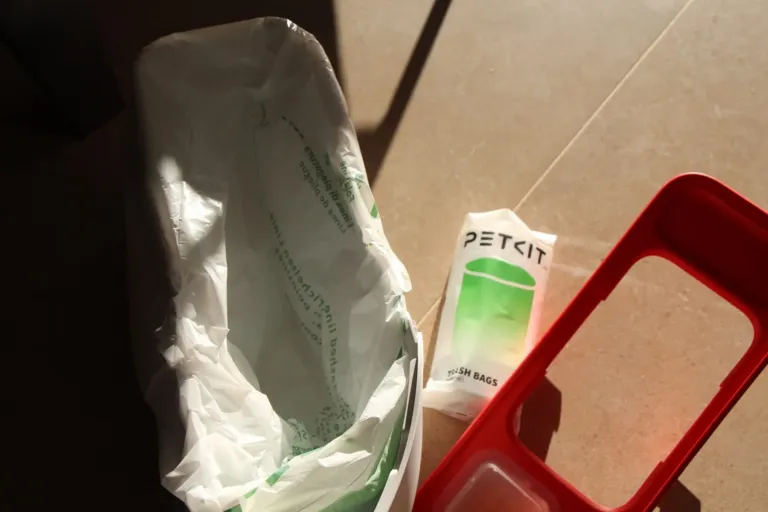
- The bin size sets your routine. Alexandra changed the bag for the first time after 15 days with one cat, exactly what Petkit claims for its 7-litre bin. Bigger bins (11 to 12 litres on the Luma, Neakasa and CATLINK) go longer between emptying, or cope with more cats.
- Budget for refills. Bags, deodorisers and litter are part of the price. “The price of the litter box alone is not the cost of using it.”
Comparison table
| Litter box | Usual UK price | Type | Cat weight | Waste bin | Camera | Warranty |
|---|---|---|---|---|---|---|
| Petkit Purobot Max 3 | £599.99 | Closed drum | 1.5 to 10 kg, from 6 months | 7 L, up to 15 days (1 cat) | No | 1 year |
| Litter-Robot 4 | from £699 | Closed globe | 1.36 to 11.33 kg | up to 8 days | No | 2 years |
| Litter-Robot 5 | from £899 | Closed globe | 1.4 to 13.6 kg | about 10 days (1 cat) | No | 2 years |
| Petlibro Luma | £699.99 | Enclosed | 1 to 10 kg, from 6 months | 11 L, up to 7 days (2 cats) | Yes, AI video | 24 months |
| Petkit PurobotMax Pro 2 | £699.99 | Closed drum | from 1.5 kg | 8 L, up to 17 days (1 cat) | Yes, AI camera | 2 years |
| Neakasa M1 Plus | £549.99 | Open top | from 1 kg to about 15 kg | 11.23 L, up to 14 days | None listed | 2 years |
| CATLINK Open-X | £229.99 | Open top | 1.5 to 10 kg | 12 L, up to 14 days | None listed | Check the listing |
| PetSafe ScoopFree SmartSpin | £399.99 | Rotating, any litter | up to 11 kg | 6 L, up to 2 weeks | None listed | Check PetSafe UK |
Prices are the usual prices on each brand’s UK store (Amazon.co.uk for CATLINK, which has no UK store). Specifications from the brands’ UK pages. Days between emptying are the brands’ claims for the number of cats shown.
Petkit Purobot Max 3: best overall for odour control
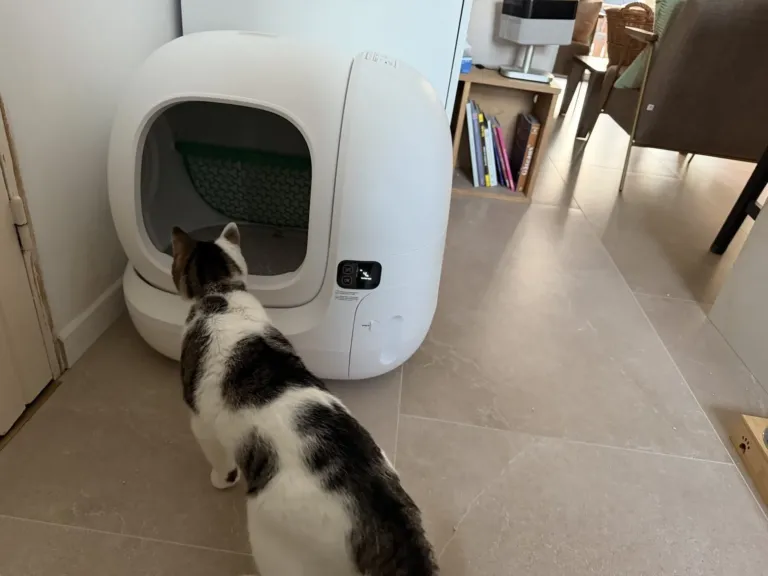
Our score: 8/10. The Purobot Max 3 is Petkit’s camera-free self-cleaning litter box: a closed 76-litre drum, a low entry 20.4 cm off the floor, a sealed 7-litre bin and Petkit’s OdorVoid odour system. Cats are told apart by their weight, and the PETKIT app records each visit, its length and the cat’s weight, with an alert when a cat stops visiting. Alexandra’s verdict:
The Petkit Purobot Max 3 premium kit is a lovely discovery. It brings real everyday comfort, notably thanks to its odour control and how easy it is to maintain.
Who it’s for: homes where the litter box sits near a living area, and anyone who wants to stop scooping without paying for a camera.
Pros: no bad smell in our tester’s kitchen, even when emptying the bin; complete app with automatic, scheduled or manual cleaning; easy to take apart and deep clean; bag changed about every 15 days with one cat; low, wide entry for older and bigger cats; kitten mode.
Cons: very bulky (62 x 53.8 x 55.2 cm, 10 kg); N50 deodoriser to replace about every 30 days at £27.99; 2.4 GHz Wi-Fi only; a shy cat needed time to adjust; 1-year warranty where the Pro 2 gets 2 years.
Price: £599.99 at Petkit UK with the N50 deodoriser. We tested the premium kit sold in France, which adds the Breezy module and N60 deodoriser: check the contents of the UK kit you choose.
See the Purobot Max 3 at the Petkit Amazon store
Litter-Robot 4: best known and best for multi-cat homes

Whisker’s Litter-Robot is the name most people know, and the one stocked by John Lewis. The globe sifts out waste after each use and drops the clumps into a sealed drawer below, with app tracking of every visit. Whisker presents it as multi-cat friendly.
Who it’s for: multi-cat homes and owners who want the most established brand, with UK support.
Pros: very wide 40 x 40 cm opening; cats from 1.36 to 11.33 kg; 2-year warranty, extendable to 4 years for £109; 90-day trial; ships from the UK site in 1 to 3 days.
Cons: up to 8 days between emptying, shorter than most rivals; no camera; liner and filter prices were not listed on the UK product page.
Price: from £699 at Litter-Robot UK, with bundles that add a mat, a step or the extended warranty.
Litter-Robot 5: best for big cats

The newest Litter-Robot keeps the globe design and raises the weight limit to 13.6 kg, the highest of the models we compared. The camera version, the Litter-Robot 5 Pro, is not sold in the UK.
Who it’s for: owners of Maine Coons and other large cats who want an enclosed box.
Pros: cats from 1.4 to 13.6 kg; 40 x 40 cm opening; about 10 days between emptying with one cat; liners priced at £25 for 25; 2-year warranty, extendable to 4 years for £129.
Cons: the most expensive model here after the Purobot Ultra; big (55.9 x 68.6 x 75.9 cm, 13 kg); no camera in the UK.
Price: from £899 at Litter-Robot UK.
Petlibro Luma: best with a camera

Petlibro’s Luma adds AI video to the self-cleaning litter box, so you can see who used it and spot changes in habits. We have tested Petlibro’s camera feeder, the Granary 2 Vision, and the brand’s app is the same kind of dashboard.
Who it’s for: multi-cat homes and owners who want to keep a close eye on a cat’s toilet habits, for example with an older cat.
Pros: AI camera; large 11-litre bin; cats from 1 to 10 kg, from 6 months; 24-month warranty; 90-day in-home trial; shipped from a UK warehouse.
Cons: up to 7 days between emptying with 2 cats; clumping, tofu or mixed litter only; must stand on a hard floor, not carpet; tall at 71.4 cm.
Price: £699.99 at Petlibro UK. Carbon deodoriser £19.99.
Petkit PurobotMax Pro 2: best Petkit with a camera

The Pro 2 is the Purobot we tested with an AI camera added. According to Petkit, the camera and weight sensors track each cat by its face, record soft stools and detect yowling, and the bin grows to 8 litres. You can set the camera’s active hours or switch it off in the app.
Who it’s for: Petkit fans with several similar-looking cats, or anyone who wants health tracking with the drum design that worked so well on odours in our test.
Pros: AI camera with multi-cat face recognition; up to 17 days between emptying with one cat; 2.4 and 5 GHz Wi-Fi; 2-year warranty; same anti-pinch drum and 12 sensors as the Max 3.
Cons: higher entry (25.5 cm against 20.4 cm on the Max 3), less easy for old or short-legged cats; bigger (65.7 x 53.8 x 60.3 cm, about 11 kg); not for cats under 1.5 kg.
Price: £699.99 at Petkit UK.
See the PurobotMax Pro 2 at the Petkit Amazon store
Neakasa M1 Plus: best open-top

Some cats will never accept a hood or a tunnel. The M1 Plus keeps the tray open: the cat steps into a wide, open bowl, and the machine sifts and empties it afterwards.
Who it’s for: cats that refuse enclosed boxes, and large breeds such as Maine Coons.
Pros: open design many cats accept more easily; cats from 1 kg to about 15 kg; large 11.23-litre bin, up to 14 days between emptying; 2-year warranty; app control.
Cons: an open tray contains smells and scattered litter less well than a closed drum; Neakasa quotes up to 50 dB, louder than the 35 dB claimed by Petkit; fast-clumping litter needed.
Price: £549.99 at Neakasa’s online store, which shows UK prices to UK visitors.
CATLINK Open-X: best budget automatic

The Open-X brings the open-top idea to a much lower price. It has a 45 cm entrance, a 12-litre bin and app control over 2.4 or 5 GHz Wi-Fi.
Who it’s for: anyone who wants to try an automatic litter box without spending £500 or more.
Pros: £229.99, the cheapest automatic model we compared; 12-litre bin, up to 14 days between emptying; cats from 1.5 to 10 kg; clumping mineral, tofu or cassava litter.
Cons: CATLINK has no UK store: the listing we found on Amazon.co.uk is sold by a third-party seller, so check the warranty and returns before you buy; heavy at 14 kg; open tray, so less odour containment.
Price: £229.99 on Amazon.co.uk.
See the CATLINK Open-X on Amazon
PetSafe ScoopFree SmartSpin: best for any litter

Most self-cleaning drums need a clumping litter with small grains. PetSafe says the SmartSpin works with any litter, with premium clumping litter recommended, so you may not have to change what your cat is used to.
Who it’s for: cats attached to their current litter, and owners who prefer an established pet brand sold widely in the UK.
Pros: works with any litter according to PetSafe; cats up to 11 kg; 6-litre bin, up to 2 weeks between emptying; app over 2.4 GHz Wi-Fi.
Cons: smaller 6-litre bin than most rivals; dimensions and warranty length not given on the UK product page.
Price: £399.99 at PetSafe UK.
See the ScoopFree SmartSpin at PetSafe UK
Also worth a look
- Petkit Purobot Ultra (£999.99): Petkit’s top model, with a camera, two-way audio, automatic waste wrapping and a 10-litre bin. Often out of stock.
- PetSnowy SNOW+ (£659): a closed drum with a 10-litre bin, up to 14 days between emptying for cats under 4 kg, and a 24-month warranty.
- PetSafe ScoopFree Crystal Pro (£307.99): uses ScoopFree crystal litter, with a tray that lasts up to 30 days according to PetSafe. You keep buying crystal litter instead of bags.
- Omega Paw Roll’n’Clean (£49.49): no motor and no app. You roll the box over and back, and the clumps slide into a pull-out tray. The cheapest way to stop scooping, when in stock.
Buying guide: how to choose a self-cleaning litter box
- Start with your cat. A shy or older cat may prefer an open-top model (Neakasa, CATLINK) or a low entry (Purobot Max 3, 20.4 cm). A big cat needs a high weight limit: up to 13.6 kg on the Litter-Robot 5.
- Closed or open. Closed drums and globes (Petkit, Litter-Robot, Petlibro, PetSnowy) contain smells and scattered litter best. Open tops are easier to accept but less discreet.
- Check the minimum weight and age. Most models need cats over 1 to 1.5 kg and recommend 6 months or older, because a light kitten may not be detected. Look for a kitten mode that pauses automatic cleaning.
- Look at the bin, then the number of cats. 6 to 8 litres means about one to two weeks with one cat; 10 to 12 litres goes longer or copes with two cats.
- Check the litter. Most drums need clumping clay, tofu or mixed litter with small grains. Crystal litter only suits crystal models such as the ScoopFree Crystal Pro. The SmartSpin takes any litter.
- Camera or not. A camera (Petlibro Luma, PurobotMax Pro 2, Purobot Ultra) tells similar cats apart and records more health data. Weight-only models (Purobot Max 3, Litter-Robot) are cheaper and still flag missed or extra visits.
- Measure the space and the floor. Allow about 55 to 70 cm each way, plus room above for maintenance. Weight sensors need a hard, level floor.
- Check Wi-Fi. Several models connect only to 2.4 GHz networks, as our tester found with the Max 3.
- Look at the trial and warranty. Whisker and Petlibro offer 90-day trials. Warranties range from 1 year (Purobot Max 3) to 2 years (Litter-Robot, Petlibro, PetSnowy, Neakasa, PurobotMax Pro 2).
What does a self-cleaning litter box really cost?
The machine is only part of the bill. Here is what you pay at the start and what you keep buying, at usual UK prices:
| Litter box | Price | Main refills |
|---|---|---|
| Petkit Purobot Max 3 | £599.99 | N50 deodoriser £27.99 about every 30 days (about £336 a year); bags from £9.99 a roll; clumping litter |
| Litter-Robot 5 | from £899 | Liners £25 for 25 (about £1 each, roughly every 10 days with one cat); clumping litter |
| Petlibro Luma | £699.99 | Carbon deodoriser £19.99; drawer liners £12.99 a pack; clumping or tofu litter |
| PetSafe ScoopFree Crystal Pro | £307.99 | Crystal trays or ScoopFree Premium Crystal Litter (£16.99 for 3.6 kg), about every 30 days |
| CATLINK Open-X | £229.99 | Bags and clumping litter |
Deodorisers are the biggest hidden cost: on the Purobot Max 3, a year of N50 refills at the manufacturer’s interval costs more than half the price of the machine. Intervals are the brands’ guidelines and depend on the number of cats.
Tips for switching your cat to a self-cleaning litter box
- Keep the old tray next to it for a few days, as our tester did when Tétine refused the new box the first night.
- Use the same litter and mix in a scoop of the old litter so it smells familiar.
- Switch off automatic cleaning at first. Clean manually or at fixed times while your cat gets used to it. It was this change that made Tétine use the box twice in a row the same night.
- Put it where the old tray was, on a hard, level floor, away from the cat’s food and water.
- Be patient. Shy cats can take days or weeks. Watch for accidents next to the box and for a cat that stops visiting; the app alerts help here.
- Deep clean once a month. Petkit recommends a regular deep clean, and our tester found taking the drum apart simple.
Frequently asked questions
Best self-cleaning litter box UK: your questions
What is the best self-cleaning litter box in the UK?
For odour control, the Petkit Purobot Max 3 (£599.99): our tester had no litter smell left in her kitchen and scored it 8/10. For the best-known brand, the Litter-Robot 4 (from £699). For big cats, the Litter-Robot 5. For a camera, the Petlibro Luma.
Do self-cleaning litter boxes work?
Yes, if your cat accepts it. Ours did after a few days of adjustment, the bag needed changing only every 15 days with one cat, and the smell disappeared. The main risk is a cat that refuses the machine, so choose a brand with a trial or start with cleaning switched off.
Are self-cleaning litter boxes safe for cats?
The models in this guide use weight and presence sensors that stop cleaning while a cat is inside or nearby. Petkit’s drums have 12 sensors and never make a full turn, so there is always a way out. Respect the minimum weight, usually 1 to 1.5 kg, and use kitten mode or manual cleaning for young cats.
How do I stop my house smelling of cat litter?
Empty waste quickly and keep it sealed. A closed self-cleaning litter box with a sealed bin and a deodoriser did this best in our test. With a classic tray, scoop daily, change the litter regularly and wash the tray.
Do vets recommend covered litter boxes?
Cats differ: some like the privacy of a hood, others avoid it. If your cat dislikes enclosed trays, choose an open-top model such as the Neakasa M1 Plus or CATLINK Open-X. Ask your vet if your cat has a urinary or mobility problem.
Does a Litter-Robot work for dogs?
No. The Litter-Robot is designed for cats, and Whisker gives weight ranges for cats only. Keep dogs away from it.
Which litter should I use?
Most drums need a clumping litter: clay, bentonite, tofu or corn, with small grains. Crystal litter does not suit them. The PetSafe ScoopFree Crystal Pro uses crystal litter, and the ScoopFree SmartSpin works with any litter according to PetSafe.
How often do I need to empty a self-cleaning litter box?
From about a week to about two weeks with one cat, depending on the bin: up to 15 days on the Purobot Max 3 (we found 15 days), up to 17 days on the PurobotMax Pro 2, about 10 days on the Litter-Robot 5, up to 14 days on the Neakasa M1 Plus. More cats means more often.
Can kittens use a self-cleaning litter box?
Most brands recommend cats from 6 months and over 1 to 1.5 kg. Until then, use a classic tray or switch off automatic cleaning with a kitten mode.
My cat is scared of the automatic litter box. What can I do?
Leave the old tray next to it, use the same litter and switch off cleaning after each visit for a while. That is what worked for our tester’s very shy cat, who then used the box twice in a row the same night.
Are self-cleaning litter boxes noisy?
Not very: Petkit quotes 35 dB for the Purobot Max 3, Petlibro 35 to 47 dB for the Luma and Neakasa up to 50 dB for the M1 Plus. Our tester found the Purobot Max 3 motor very discreet. It is the movement of the drum, more than the sound, that can worry a nervous cat at first.
Can several cats share a self-cleaning litter box?
Yes. Weight-based models such as the Purobot Max 3 tell cats apart by weight, and camera models such as the Petlibro Luma and PurobotMax Pro 2 recognise cats of similar weight. A bigger bin helps with more cats.
How much does a self-cleaning litter box cost to run?
It depends on the refills. On the Purobot Max 3, the N50 deodoriser costs £27.99 about every 30 days, plus bags and litter. Litter-Robot 5 liners cost about £1 each. Open-top models without a deodoriser cost less to run.
Our verdict
Choose your self-cleaning litter box for your cat first, then for your home. If smells are the problem and your cat accepts a closed box, the Petkit Purobot Max 3 did exactly what we hoped in our test, for less than the camera models. If you want the most established brand, the Litter-Robot 4, or the Litter-Robot 5 for a big cat. If you want to watch over a cat’s health, the Petlibro Luma. And if your cat refuses hoods, go open-top with the Neakasa M1 Plus or, on a budget, the CATLINK Open-X. Whatever you choose, give your cat time, and count the refills in your budget.
Update log and sources
- November 2026: guide published. Usual prices and specifications from the official UK stores of Petkit, Whisker (Litter-Robot), Petlibro, PetSafe and PetSnowy, Neakasa’s online store, Amazon.co.uk (CATLINK) and Zooplus UK (Omega Paw), checked on 24 November 2026.
- Our test: Petkit Purobot Max 3 review. See also our Petlibro Granary 2 Vision review.
Questions & reviews
Have a question about this box?
Share a question, opinion or experience. Our team reads every message and will reply.