
 By
Michaël Maarek
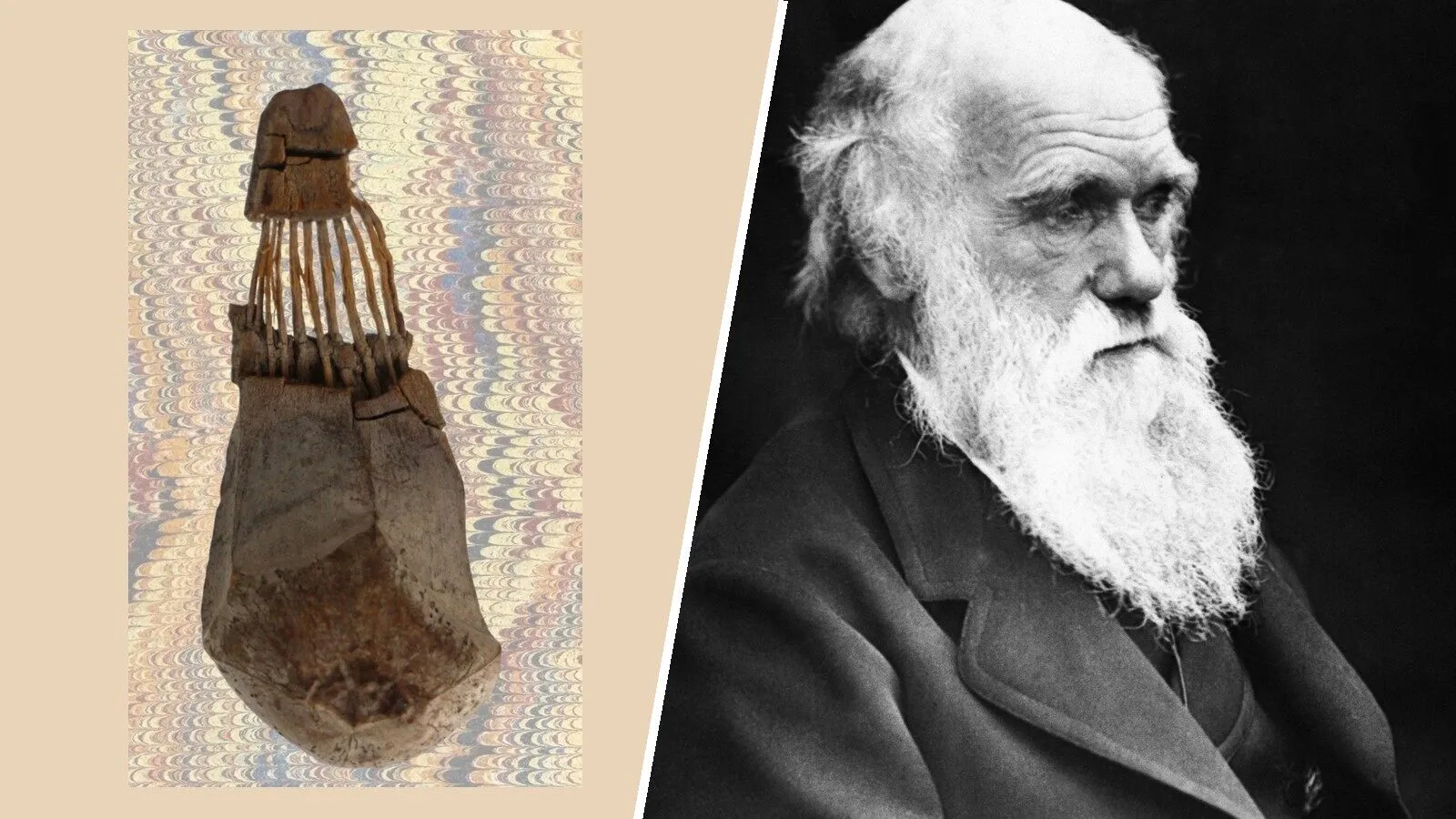
Two small pine cone specimens believed to have been prepared by Charles Darwin, the naturalist behind the theory of evolution and the face on the old £10 note, go under the hammer on 2 December in Whitchurch, Shropshire. They were found wrapped in a scrap of oil cloth under a collapsed brick shed, in a garden built on the site of the Darwin family’s vinery at The Mount, his childhood home in Shrewsbury. Trevanion Auctioneers gives each one an estimate of £1,000 to £2,000, with bids open online from £900, and the money goes to a new respiratory unit for Shrewsbury and Telford hospitals.
Found under a collapsed shed
The vendor lives in Darwin Gardens, a house built in 1932 on the land of the Darwin family’s vinery. Her garden backed onto the rear terrace of The Mount and the old servants’ areas: the brewery, the dairy, the laundry, the poultry sheds and the stables.
While restoring the run-down garden, she cleared the remains of a collapsed brick shed. Underneath were crockery fragments, buttons, coins, a toy cannon and a piece of oil cloth. Wrapped inside the oil cloth were two pine cone scales, or bracts, each only a few centimetres long.
These are not ordinary bits of pine cone. On both, part of the outer tissue has been carefully cut away to show the vascular bundles inside, the thin fibres that carry water through the plant. According to the auction house, specialists at the Natural History Museum examined them in 2014 and concluded that they had been prepared for study “by the hand of a skilled naturalist”. Their view was that Darwin had probably prepared them himself and then thrown them away.

Before or after the Beagle?
Darwin was born in Shrewsbury in 1809 and grew up at The Mount, the house built by his father, the doctor Robert Darwin. He collected beetles and plants there in his school and university holidays, until he left in 1831 on HMS Beagle, the five-year voyage that led to On the Origin of Species. He came back briefly in 1836, kept visiting until his father died in 1848, and is known to have sent seed specimens to the house to be planted.
So nobody can say exactly when the specimens were made. Christina Trevanion, who runs the auction house and is familiar to BBC viewers from Bargain Hunt and Antiques Road Trip, said at the launch of the catalogue: “It’s extraordinary to think that these specimens could have belonged to one of the greatest scientific minds in history. It seems highly likely that they were prepared by a youthful Charles Darwin, conducting research and experiments at his childhood home, before setting off on The Beagle.” She added: “But it’s equally possible that he brought them with him from The Beagle on his return home, or sent them later to his father.”
The Darwin lots and their prices
The specimens are part of Trevanion’s December Fine Art & Antiques Auction, with four lots from the same garden:
- Lot 410: a pine cone scale or bract specimen, 4.5 cm long, possibly from a stone pine or a maritime pine. Estimate £1,000 to £2,000, opening bid £900.
- Lot 411: the second specimen, 3.8 cm long. Estimate £1,000 to £2,000, opening bid £900.
- Lot 409: a mix of objects from the garden, including an apothecary bottle from the Salop Infirmary, where Robert Darwin worked as a doctor, a Masonic ring (Robert was a member of the local lodge), an ink bottle, a corkscrew, a fleem (an old bloodletting tool), a toy cannon, a spoon, keys and buttons. Estimate £500 to £700.
- Lot 408: 11 coins from the garden, including a George III halfpenny from 1772, a George III “cartwheel” penny from 1797 and an Austrian kreuzer from 1816. Estimate £100 to £200.
The four lots are sold in aid of the Friends of Shrewsbury and Telford Hospital, which will use the money to help fund a new respiratory unit.
How to bid
The live sale starts on Wednesday 2 December 2026 at 10:00 and runs into 3 December. You can bid in the room in Whitchurch, by phone or online, after registering on the auction platform. Remember the extra fees: the platform lists a buyer’s premium of 34.74% including VAT, so a £1,000 hammer price would cost £1,347.40 before any shipping.
What we think
We like this sale because it is the opposite of the usual celebrity auction. There is no glass case, no signed photo and no six-figure estimate: just two tiny, carefully dissected pieces of pine cone, hidden for decades under a garden shed next to the house where the young Darwin learned to look closely at nature. At £1,000 to £2,000, it is also one of the few chances to own something with a real Darwin story for the price of a good laptop, and the money goes to a hospital unit.
Our reservations are about the proof. The link to Darwin rests on where the specimens were found and on the Natural History Museum’s 2014 opinion that he “probably” prepared them. There is no label, note or handwriting tying them to him, so the price reflects that. We have not seen the specimens in person; everything here comes from the auction catalogue and the auctioneer’s statements.
Price and availability
- What: two pine cone bract specimens believed to have been prepared by Charles Darwin, plus coins and objects from the same garden.
- Estimates: £1,000 to £2,000 for each specimen (opening bid £900), £500 to £700 for the objects, £100 to £200 for the coins.
- Fees: buyer’s premium of 34.74% including VAT on top of the hammer price.
- When: Wednesday 2 December 2026, from 10:00 UK time.
- Where: Trevanion Auctioneers & Valuers, Whitchurch, Shropshire, and online.
- Good cause: Friends of Shrewsbury and Telford Hospital, for a new respiratory unit.
Frequently asked questions
Charles Darwin pine cone auction: your questions
Are the pine cone specimens definitely Charles Darwin’s?
No. They were found on the site of the Darwin family’s vinery at The Mount in Shrewsbury, and according to the auction house, Natural History Museum specialists concluded in 2014 that they had probably been prepared by Darwin and then discarded. There is no label or handwriting to prove it.
How much are they expected to sell for?
Each of the two specimens has an estimate of £1,000 to £2,000, with an opening bid of £900. A buyer’s premium of 34.74% including VAT is added to the hammer price.
When and where is the auction?
At Trevanion Auctioneers & Valuers in Whitchurch, Shropshire, in the December Fine Art & Antiques Auction, which starts on Wednesday 2 December 2026 at 10:00. You can also bid online.
What else from Darwin’s childhood home is for sale?
A lot of objects found in the same garden, including a Salop Infirmary apothecary bottle, a Masonic ring and a toy cannon (estimate £500 to £700), and a lot of 11 old coins (estimate £100 to £200).
Where does the money go?
The lots are sold in aid of the Friends of Shrewsbury and Telford Hospital, which will use the money to help fund a new respiratory unit.
See the lots and register to bid: Charles Darwin pine cone specimen, lot 410, lot 411 and the full Trevanion December sale.
Questions & reviews
Have a question about this box?
Share a question, opinion or experience. Our team reads every message and will reply.